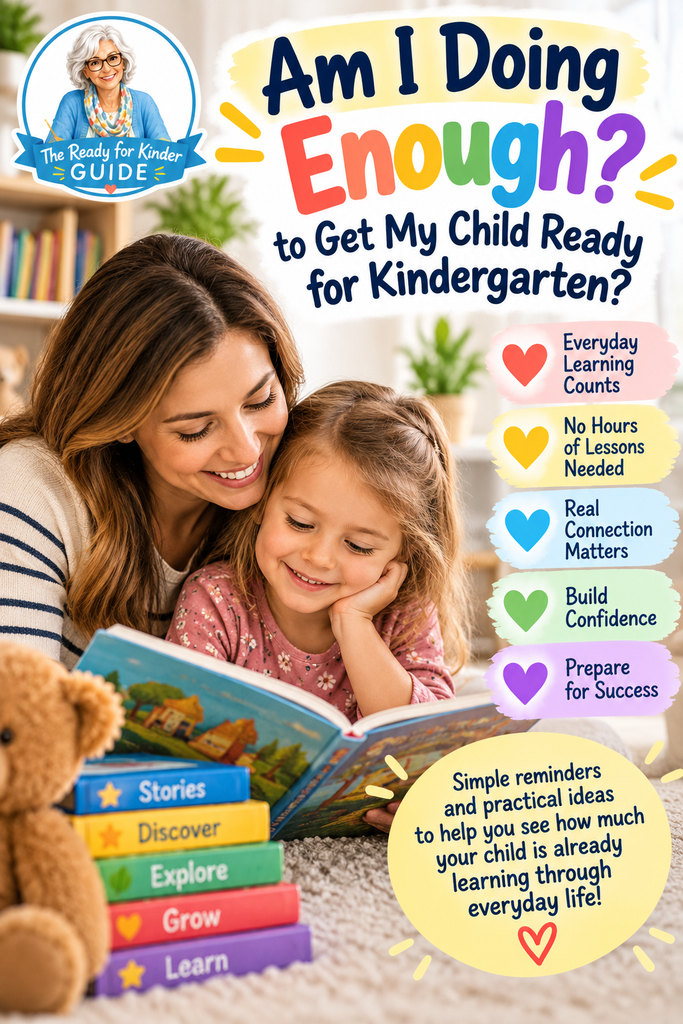
Am I Doing Enough to Get My Child Ready for Kindergarten?
Maybe you’ve seen the kindergarten-readiness checklists.
Your child should know some letters. Count objects. Use scissors. Follow directions. Take turns. Put on a coat. Recognize their name. Hold a pencil. Open their lunch containers.
And suddenly you’re wondering:
Are we doing enough?
- Maybe you see another parent sharing the preschool activities they’re doing at home.
- Maybe your friend mentions that her 4-year-old is already reading.
- Maybe you bought a preschool workbook with the best intentions, but it’s been sitting untouched on the shelf for three weeks.
And kindergarten keeps getting closer.
So you start wondering whether you should be doing more.
- More letter practice.
- More number practice.
- More educational activities.
- More structured learning.
If that’s where you are today, here’s something I want you to know:
Getting your child ready for kindergarten doesn’t require turning your home into a classroom.
Your child is learning far more than you may realize.
Kindergarten Readiness Is Bigger Than ABCs and 123s
When parents think about preparing for kindergarten, academics often come to mind first.
- Does my child know the alphabet?
- Can they count?
- Can they write their name?
Those skills have value, but they’re only part of kindergarten readiness. Think about everything else your child will need to do during a typical kindergarten day.
They’ll need to:
- Listen to another person.
- Follow simple directions.
- Wait for a turn.
- Communicate what they need.
- Try something that feels difficult.
- Take care of some of their belongings.
- Use the bathroom independently.
- Clean up after an activity.
- Play and work with other children.
- Handle disappointment.
- Ask for help.
- Solve simple problems.
- Separate from you for part of the day.
Children develop many of these skills through ordinary family life. You may be doing much more kindergarten preparation than you think.
Learning Happens During Everyday Life
You don’t have to announce, “It’s learning time!” for learning to happen.
- Imagine a typical trip to the grocery store. Your child helps you count four apples. That’s early math.
- You ask whether you need the big box or the little box. That’s comparison and measurement.
- Your child recognizes the first letter on the cereal box. That’s early literacy.
- You talk about why the ice cream has to stay cold. That’s science.
- Your child says hello to the cashier. That’s communication and social development.
- They help carry a light bag into the house. That’s independence and responsibility.
You didn’t create a lesson plan. You went grocery shopping. And your child learned.
Look at What Happens at Home
The same thing happens throughout your day.
When your child helps make breakfast…
They’re measuring, counting, following directions, building vocabulary, and practicing fine-motor skills.
When they put away their toys…
They’re sorting, organizing, following routines, and developing responsibility.
When you read a bedtime story…
They’re building vocabulary, listening comprehension, attention, imagination, and an understanding of how stories work.
When they build with blocks…
They’re experimenting with balance, shapes, spatial relationships, planning, and problem-solving.
When they play restaurant…
They’re developing language, imagination, social skills, early math, and an understanding of the world around them.
When they help set the table…
They’re counting, matching, following a sequence, and contributing to the family.
When they put on their own shoes…
They’re developing independence, coordination, persistence, and confidence.
When you talk in the car…
They’re learning vocabulary, conversation skills, listening, storytelling, and how to express their ideas.
These things count.
In fact, they’re some of the most natural ways young children learn.
Your Child Doesn’t Need Hours of Structured Lessons
There is nothing wrong with doing a preschool worksheet occasionally if your child enjoys it.
There’s nothing wrong with practicing letters.
There’s nothing wrong with sitting together and doing an intentional learning activity.
But you don’t need to recreate a preschool classroom at home.
A 4-year-old doesn’t need several hours of formal lessons every day to be preparing for kindergarten.
Instead, look for small opportunities to learn throughout the day.
- Count the stairs as you walk up them.
- Look for the letter that begins your child’s name while you’re running errands.
- Talk about the shapes you see.
- Ask your child to help sort the laundry.
- Let them measure ingredients while you’re cooking.
- Read together.
- Sing songs.
- Tell silly rhymes.
- Ask questions.
- Let your child ask questions, too.
- Play.
Those little moments add up.
Connection Is More Important Than Creating the Perfect Learning Activity
Sometimes we get so focused on teaching that we forget one of the most important things young children need:
Connection.
- Your child learns when you sit together and read a book.
- They learn when you listen to a long story about something that happened during playtime.
- They learn when you answer the fifteenth “Why?” of the afternoon.
- They learn when you cook together.
- They learn when you play a board game.
- They learn when you go outside and wonder together why one leaf is green and another is yellow.
- They learn when you say, “That’s a good question. Let’s find out.”
You don’t have to turn every moment into a lesson. Sometimes the conversation itself is the lesson.
You Don’t Have to Teach Everything Before Kindergarten
This one is important. Your child is going to kindergarten to learn. They don’t have to arrive knowing everything they’ll be taught there.
Children enter kindergarten with different experiences, abilities, personalities, strengths, and areas where they still need support. That’s normal.
Your job isn’t to make sure your child has mastered kindergarten before kindergarten begins. Instead, you can help build a foundation for learning.
- Encourage curiosity.
- Read together.
- Talk together.
- Give your child opportunities to do things independently.
- Let them solve manageable problems.
- Help them practice being around other children.
- Teach them how to ask for help.
- Encourage them when something feels difficult.
- Help them discover that learning can be enjoyable.
Those skills will serve your child well long after they’ve learned their letters and numbers.
What If My Child Really Does Need Practice?
Reassurance doesn’t mean ignoring skills your child is struggling with.
- Maybe you’ve noticed that your child avoids drawing because holding a crayon is difficult.
- Perhaps counting objects is still confusing.
- Maybe separating from you is particularly hard.
- Or your child becomes very frustrated when something doesn’t go as planned.
Those observations can help you decide where to provide a little extra practice. But you still don’t need to work on everything at once. Choose one small skill and look for simple ways to practice it naturally.
- If hand strength is difficult, try play dough, clothespins, spray bottles, building toys, or helping in the kitchen.
- If counting is difficult, count crackers at snack time or cars in the parking lot.
- If independence is challenging, choose one daily task your child can begin doing for themselves.
- If taking turns is difficult, play a short family game.
A few minutes woven into everyday life can be more manageable—for both of you—than trying to create a formal lesson.
Try Asking a Different Question
Instead of ending the day by asking: “Did I do enough to get my child ready for kindergarten today?”
Try asking: “What did my child learn today?”
The answer might surprise you.
- Maybe your child learned that adding another block made the tower fall.
- Maybe they figured out how to zip their jacket.
- Maybe they noticed that two words rhyme.
- Maybe they counted five strawberries.
- Maybe they waited for a sibling to finish with a toy.
- Maybe they asked a wonderful question.
- Maybe they helped you make dinner.
- Maybe they tried something difficult and didn’t give up.
- Maybe they made a mistake—and tried again.
- Maybe you simply curled up together and read a favorite story for the tenth time.
Learning happened.
A Simple “My Child Learned Today” Reflection
If you find yourself worrying about whether you’re doing enough, try this little exercise at the end of the day.
Finish these sentences:
Today my child…
- Tried something independently: __________
- Asked or answered an interesting question: __________
- Practiced a social or emotional skill: __________
- Used numbers, shapes, patterns, or measurement: __________
- Played with words, letters, books, stories, or rhymes: __________
- Created, built, explored, or solved a problem: __________
- Helped with an everyday task: __________
- Learned something I wasn’t intentionally teaching: __________
You certainly don’t need something in every category every day.
This isn’t another checklist to complete.
It’s simply a way to notice the learning that’s already happening.
So…Are You Doing Enough?
There isn’t a perfect kindergarten-preparation formula.
There isn’t a certain number of educational activities you have to complete each week.
And there isn’t one version of a “kindergarten-ready” child.
- Keep reading together.
- Keep talking.
- Keep playing.
- Give your child opportunities to help.
- Let them try things for themselves.
- Answer their questions—and ask some of your own.
- Notice what interests them.
- Practice skills when they need practice.
- And enjoy your child while they’re still four.
You don’t need to make every moment educational.
Everyday life already offers plenty of opportunities to learn.
Your job isn’t to create a perfect little kindergartener. It’s to help your child grow into a curious, confident learner who knows that home is a safe place to ask questions, make mistakes, try again, and discover something new. That’s a pretty wonderful way to get ready for kindergarten.
This post was created with the help of AI.
Links in this post may be affiliate links. Purchases made through these links will not cost you more, but may earn me an affiliate fee.
We are a participant in the Amazon Services LLC Associates Program, an affiliate advertising program designed to provide a means for us to earn fees by linking to Amazon.com and related sites. Thank you for using my links.
Read more Parent Support posts
Did you enjoy this post? Click the like button to help others find it.
Check out my lists on Benable
Want to help support this blog? You can leave a tip here. Or make any purchase on Amazon with my link, or shop in my Amazon storefront. Where I have a section of products suggested by Ready for Kinder.