

How Can I Help My Preschooler Build Pre-Writing Skills Without Using Worksheets?
When parents hear the words pre-writing practice, it’s easy to picture a preschooler sitting at the table tracing rows of dotted lines.
Straight lines. Curvy lines. Circles. Letters.
Those activities can have a place, but they aren’t the only—or even necessarily the best—way for a young child to get ready to write.
Before children can comfortably control a pencil, their hands, fingers, arms, eyes, and even their whole bodies have a lot of work to do.
The good news? Much of that work looks a lot like play.
Links in this post may be affiliate links. Purchases made using these links will not cost you more, but may pay me an affiliate fee.
We are a participant in the Amazon Services LLC Associates Program, an affiliate advertising program designed to provide a means for us to earn fees by linking to Amazon.com and related sites. Thank you for using my links.
If your preschooler isn’t interested in tracing pages—or you’d simply like to add more playful learning to your day—here are 15 ways to build pre-writing skills without pulling out a single worksheet.
What Are Pre-Writing Skills?
Writing requires children to coordinate several abilities at once. They need enough strength to hold and control a pencil, enough finger dexterity to make small movements, and enough visual-motor coordination to guide their hand where they want it to go.
Children also gradually learn the basic movements and shapes that appear again and again in writing—such as vertical and horizontal lines, circles, curves, diagonals, and crosses.
That’s why pre-writing practice doesn’t have to mean writing letters.
Activities that encourage your child to squeeze, pinch, grasp, reach, draw, twist, place, and move can all contribute to the foundation they’ll eventually use for handwriting.
Here are some simple ways to practice.
1. Make Play Dough Snakes
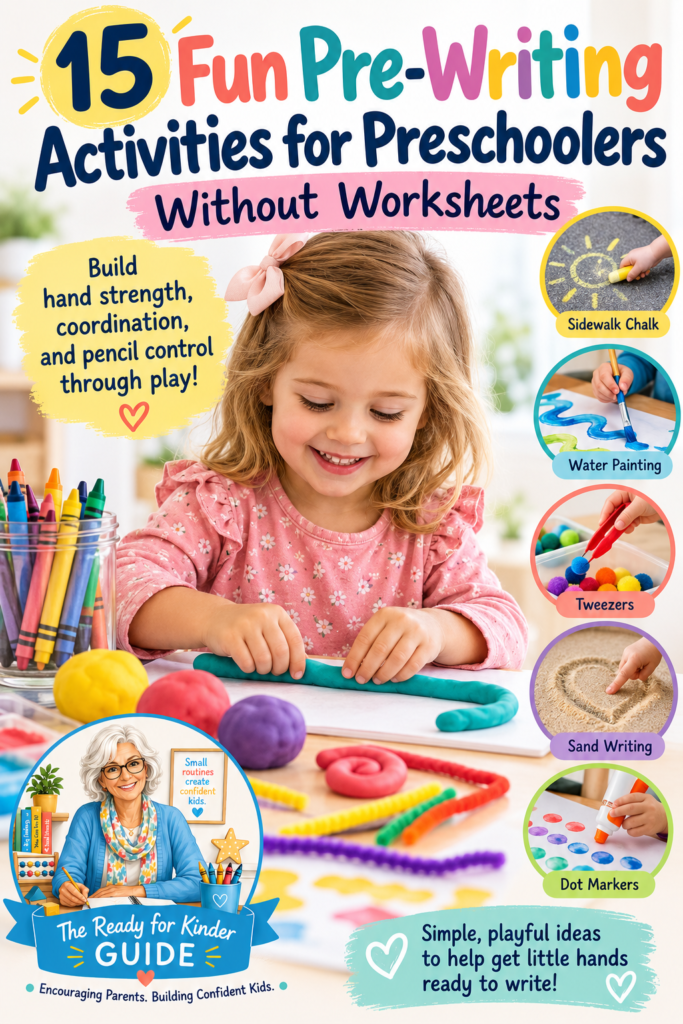
Give your child some play dough and show them how to roll it into long “snakes.”
Once they’ve mastered that, try turning the snakes into circles, crosses, squares, zigzags, or even simple letters.
Rolling, pinching, and shaping the dough strengthens little hands while introducing some of the shapes and movements used in writing.
Pre-writing practice: Hand strength, finger control, bilateral coordination, and shape formation.
2. Finger Paint
Finger painting lets children make large writing-like movements without having to control a pencil.
Encourage your child to experiment with straight lines, circles, swirls, waves, and zigzags—or let them create freely.
The sensory experience is part of the learning, too.
Pre-writing practice: Finger isolation, hand-eye coordination, directionality, and early mark-making.
3. Draw With Sidewalk Chalk
Take pre-writing practice outside!
Sidewalk chalk gives preschoolers plenty of room to make big movements with their entire arms. Draw roads, giant circles, lines, shapes, or silly pictures.
You can also make a simple path of lines and curves and invite your child to follow it with their chalk.
Pre-writing practice: Shoulder stability, arm control, hand-eye coordination, and line formation.
4. Write in Sand
Fill a shallow tray with a thin layer of sand and let your child draw with one finger.
Start with free exploration. Later, you can demonstrate a straight line, circle, cross, or other simple shape and ask your child to try it.
A quick shake of the tray erases everything, which makes mistakes feel wonderfully unimportant.
Pre-writing practice: Finger isolation, shape formation, sensory exploration, and visual-motor skills.
5. Try Shaving Cream Writing
Spread a small amount of shaving cream on a washable tabletop or tray and let your child draw through it with a finger.
Make lines, shapes, faces, pictures, or eventually letters.
Yes, this one is messy. That’s also probably why your preschooler will remember it.
Pre-writing practice: Finger control, sensory learning, shape formation, and confidence with mark-making.
Parent tip: Make sure the product you use is appropriate for your child and supervise the activity so little hands stay away from eyes and mouths.
6. Paint With Water
This may be one of the easiest activities on the list.
Give your child a paintbrush and a cup of water and head outside. Let them “paint” the sidewalk, fence, patio, or another water-safe surface.
Try different brush sizes. A larger brush encourages whole-arm movements, while a smaller one requires more control.
And cleanup couldn’t be easier.
Pre-writing practice: Grip, wrist control, shoulder strength, and hand-eye coordination.
7. Create Sticker Scenes
Give your child stickers and a large piece of paper and let them create a picture or scene.
Peeling stickers from the sheet requires children to use their fingertips in ways that help strengthen the small muscles needed for pencil control.
Once the picture is finished, ask your child to tell you what’s happening. Now you’ve added storytelling and language development to the activity.
Pre-writing practice: Pincer grasp, finger dexterity, visual planning, and hand-eye coordination.
8. Use Lacing Cards
Threading a lace through small holes requires concentration and coordination.
You can purchase preschool lacing cards or make simple ones from sturdy cardboard with holes punched around the edges.
Don’t worry about whether your child follows a particular pattern. The threading itself provides valuable practice.
Pre-writing practice: Bilateral coordination, hand-eye coordination, finger dexterity, and concentration.
9. Play With Dot Markers
Dot markers give children a satisfying way to practice controlled hand movements.
Let your child make pictures, patterns, rows, or designs. You can also draw large lines or shapes and have your child place dots along them.
Pre-writing practice: Hand-eye coordination, controlled movements, visual tracking, and patterning.
10. Move Small Objects With Tweezers
Put pom-poms, cotton balls, or other child-safe objects in one container and let your preschooler use child-sized tweezers or tongs to transfer them to another.
You can make the game more challenging by sorting the objects by color or placing them into sections of an ice cube tray.
Pre-writing practice: Hand strength, pincer grasp, precision, and coordination.
Safety note: Small objects can be choking hazards, so choose materials appropriate for your child’s age and supervise closely.
11. Play With Clothespins
Opening a clothespin requires more hand strength than you might expect.
Let your child clip clothespins around the edge of a cardboard box, paper plate, or sturdy container.
You can add colors, numbers, or matching later if your child enjoys it, but simple clipping is plenty of practice.
Pre-writing practice: Finger strength, hand strength, coordination, and precision.
12. Bend and Twist Pipe Cleaners
Pipe cleaners are wonderfully versatile.
Children can bend them into circles, spirals, zigzags, people, animals, or whatever they imagine.
Try wrapping them around a pencil to make a spiral or joining several together to create something larger.
Pre-writing practice: Finger strength, bilateral coordination, manipulation, and creative problem-solving.
13. Finger Trace
Finger tracing can introduce pre-writing movements without requiring pencil control.
Trace a line or shape on paper and have your child follow it with a finger. You can also trace shapes on carpet, textured fabric, or another tactile surface.
Eventually, try simple letters—especially the letters in your child’s name—but don’t rush.
Pre-writing practice: Directionality, visual tracking, shape recognition, and motor planning.
14. Dance With Ribbons
This one might not look like handwriting practice at all—and that’s exactly what makes it fun.
Give your child a ribbon wand or a length of ribbon that’s safe for supervised play. Put on some music and encourage big circles, waves, loops, and lines in the air.
Those large movements help develop the shoulder and arm stability children need before they can comfortably control smaller hand movements.
Pre-writing practice: Gross-motor control, shoulder strength, crossing the midline, rhythm, and movement patterns.
15. Paint With Cotton Swabs
Swap a regular paintbrush for cotton swabs and let your child paint dots, lines, pictures, and patterns.
Because the tool is small, children need more precise finger and hand movements.
Try making a simple dotted line or shape for your child to follow—or let them create their own masterpiece.
Pre-writing practice: Precision, fine-motor control, hand-eye coordination, and controlled mark-making.
You Don’t Need to Turn These Into Lessons
Once you know the skills you’re looking for, it’s tempting to turn every activity into an assignment.
Try not to.
Your child doesn’t need to make ten vertical lines before they can finger paint a dinosaur.
You don’t need to quiz them about shapes while they’re playing with dough.
And their sidewalk chalk doesn’t need to become handwriting practice every time you go outside.
Give your child plenty of opportunities to use their hands and body in different ways. Occasionally model a new movement or introduce a little challenge, and then let them explore.
Play does more teaching than it may appear.
What About Pencil Practice?
Avoiding worksheets doesn’t mean your child should never use pencils, crayons, or markers.
Drawing and scribbling are wonderful pre-writing activities, too.
Keep paper and drawing materials within reach and encourage your child to create whenever they’re interested. As kindergarten gets closer, you can naturally add opportunities to draw shapes, write their name, or try simple letter forms.
The difference is that pencil practice becomes one part of pre-writing development, not the whole thing.
Make It Easy: A 30-Day Pre-Writing Activity Calendar
If you’re reading this list and thinking, ” These are great ideas, but I’ll never remember to do them, that’s exactly where a simple plan can help.
The 30-Day Pre-Writing Activity Calendar gives you one playful activity to try each day.
No long lessons. No stack of worksheets. No need to plan a month’s worth of activities yourself.
Just a few minutes of squeezing, pinching, painting, drawing, moving, and creating—building important skills, one step at a time.
Kindergarten Readiness Can Look Like Play
Getting ready to write doesn’t begin with perfectly formed letters.
- It begins when little hands squeeze play dough.
- When fingers peel stickers.
- When arms sweep chalk across a driveway.
- When a child carefully moves a pom-pom with tweezers or swirls a ribbon through the air.
These activities may not look much like handwriting practice, but they’re helping build the strength, coordination, control, and confidence your child will need when pencils and paper become a bigger part of the school day.
So if your preschooler would rather paint with water than trace another dotted line?
That’s okay. They’re still getting ready for kindergarten.
Helpful Pre-Writing Supplies
You don’t need special equipment to help your preschooler develop pre-writing skills. Many of the activities in this post use ordinary household supplies. But if you’d like to put together a small pre-writing activity basket, these are some useful items to have on hand.
Play-Doh Modeling Compound
Rolling, squeezing, pinching, and shaping dough strengthens the hands and fingers children will eventually use to control a pencil.
Amazon search: Play-Doh Modeling Compound
Crayola Washable Finger Paint
Finger painting gives children a chance to practice lines, circles, curves, and other pre-writing movements without worrying about holding a pencil correctly. A washable variety makes this activity a little more parent-friendly!
Amazon search: Crayola Washable Finger Paint
Crayola Washable Sidewalk Chalk
The larger movements children make when drawing on a sidewalk or driveway help develop arm and shoulder control as well as early drawing skills. Crayola’s washable sidewalk chalk comes in an easy-to-grip, larger size.
Amazon search: Crayola Washable Sidewalk Chalk
Do A Dot Art! Markers
These chunky dot markers are easy for preschool hands to manage and can be used for free art, patterns, following lines, or filling simple shapes. The sponge-tip design also eliminates the need for separate brushes or paint cups.
Amazon search: Do A Dot Art Markers
Preschool Lacing Cards
Lacing is wonderful practice for coordinating both hands while developing finger dexterity and hand-eye coordination. Look for sturdy cards with large holes and thick laces that preschoolers can manage.
Amazon search: Preschool Lacing Cards
Learning Resources Helping Hands Fine Motor Tool Set
I especially like this one for the post because one purchase can cover several different activities. The set includes child-friendly grabbing, squeezing, and transferring tools designed to strengthen fine-motor skills.
Amazon search: Learning Resources Helping Hands Fine Motor Tool Set
Melissa & Doug Reusable Sticker Pads
Peeling and positioning stickers work those little fingertips while encouraging creativity and storytelling. Reusable sticker scenes also let children move the pieces around and create something new each time.
Amazon search: Melissa & Doug Reusable Sticker Pads
Jumbo Preschool Tweezers
If you don’t want a complete fine-motor set, a pair of child-sized tweezers is an inexpensive alternative. Add pom-poms, cotton balls, or other age-appropriate objects and let your child transfer and sort them.
Amazon search: Jumbo Preschool Tweezers
Large Preschool Paintbrushes
Keep a few different-sized brushes available for outdoor water painting, regular painting, or even “painting” lines and shapes. Larger brushes encourage whole-arm movements while smaller brushes require greater control.
Amazon search: Preschool Paintbrushes
Preschool Craft Supply Kit
For pipe cleaners, pom-poms, craft sticks, and other odds and ends, a general preschool craft assortment can be convenient. Just remember that kits containing small pieces require close adult supervision.
Amazon search: Preschool Craft Supply Kits
Ready for Kinder Tip
You don’t need a cupboard full of special learning materials. Play dough, chalk, paint, stickers, tweezers, and a few craft supplies can provide dozens of opportunities for pre-writing practice. Store a few favorites together in a basket and pull it out when your preschooler needs something to do.
Read more posts about Pre-Writing and its role in Kindergarten Readiness.
Did you enjoy this post? Be sure to click the like button to help others find it.
Check out my lists on Benable
Want to help support this blog? You can leave a tip here. Or make any purchase on Amazon with my link, or shop in my Amazon storefront. Where I have a section of products suggested by Ready for Kinder.
This post was written with AI help.


